While the world looks North, our Southern Sky quietly steals the show
Your August & September sky guide — from the dark skies of the Coffs Coast
There's a lot of noise this August about the Northern Hemisphere's big night — a total solar eclipse tracking across Iceland and Spain, and the famous Perseid meteor shower raining down over Europe. It's spectacular stuff. But here's what they won't tell you from up there: standing on the Mid North Coast of NSW, under genuinely dark skies at Look At Me Now Headland, we've got a front-row seat to a sky that's entirely our own — and in a few ways, we come out ahead.
Venus is the jewel of it. Right now she's blazing in our western evening sky, and by mid-September she'll be so brilliant you could pick her out in broad daylight if you know where to look. Saturn is climbing back into the evening, its rings sharpening night by night as it builds toward opposition in October. And low in the south, a comet is drifting through Capricorn — faint to the naked eye, but a real treat through the telescope under dark skies like ours.
The Perseids will still send a few bright, fast fireballs skimming our northern horizon before dawn — a quieter show than the north gets, but ours to catch all the same. And on the 16th, keep an eye out as a slender crescent Moon slides up beside Venus for one of the prettiest pairings of the season.
So while the headlines point north, the invitation here is simple: come and look up with us. Here's exactly what's happening in the sky above the Coffs Coast this August and September.
PLANETS — AUGUST / SEPTEMBER 2026
The Sun, our central star, arrives at the Spring Equinox on 23rd September at 10:05am Eastern Australian time. Crossing the equator southbound marks the beginning of the southern Spring and northern Autumn.
Mercury will stay close to the Sun for most of August and September. Currently in the morning sky, it will pass “behind” the Sun (this is called superior conjunction) in the last week of August before re-emerging for evening viewers in September, and will be favourably placed through most of October.
Venus is now as far west of the Sun as it is going to be during this cycle. It is unmistakeable in the dark, western sky as it passes through Virgo this month. Maximum brightness in the second half of September means that it will be visible in daylight if you know where to look. Binoculars will show it as a “first quarter” phase (same as the Moon) and then as a thinning crescent increasing rapidly in size until it disappears in front of the Sun (inferior conjunction) in October. It will be back in the evening sky around late September 2027.
Mars rises at about 03:00 during August and is easily found in Gemini. It forms a striking right-angled triangle of red with Betelgeuse and Aldebaran. It will return to the evening sky, rising just before midnight, at Christmas.
Jupiter, past conjunction, is now in the morning sky, rising about an hour before the Sun, and still lost in the solar glare.
Saturn continues its return to the evening sky, rising at around 21:30 during August. This planet reaches opposition on 4th October, rising at sunset and remaining in the evening sky for spring and summer.
The Moon is New on 13th August; First Quarter on 20th; Full on 28th; Last Quarter on 4th September; New on 11th; First Quarter on 19th; Full on 27th; and Last Quarter on 3rd October.
METEOR SHOWER & COMET
Meteor Shower — Perseids, 12–13 August. Parent body is Comet 109P Swift-Tuttle, which orbits the Sun every 133 years. It will return again in 2125.
Comet 10P/Tempel. Closest approach to the Sun on 2nd, to Earth on 3rd. Very well placed for southern observers in the constellation of Capricorn, but already receding. It will remain above the horizon for most of the night during August, but it's already below the naked-eye limit, so dark sky, binoculars or a telescope are required. Orbital period is around 5.4 years.
An excellent information resource: https://starwalk.space/en/news/comet-10p-tempel-2
Clear skies, everyone.
Gordon Nurse
Starry Night Tours Coffs Harbour
https://www.starrynighttours.com.au
August and Spring Holiday dates (Queensland and NSW) are now available for bookings!
Click “Whats On” and book your tour today
COMING UP IN AUGUST
Total Solar Eclipse — 12th August 2026
Path of totality: Eastern Greenland, Iceland, western Atlantic, Spain, Portugal.
NASA live stream from 13:15 US Eastern (03:15 on 13th EAST). Others available through paid streaming services.
NASA coverage: https://www.nasa.gov/news-release/nasa-sets-coverage-for-august-northern-hemisphere-total-solar-eclipse/
Full details with track graphics: https://www.timeanddate.com/eclipse/solar/2026-august-12
Perseid Meteor Shower (peaks 12–13 August)
A famous shower most favourably viewed from the Northern Hemisphere, associated with Comet Swift-Tuttle (109P). This year the shower peaks on the night of 12th August, which coincides with the New Moon. Its radiant, which is where the comet orbit crosses our own, is just below our northern horizon at its “highest” point, so Southern Hemisphere observers do not get the full effect.
The meteors are bright and fast with long tails and often include fireballs. In northern Europe, the ZHR* is expected to exceed 120 (or 2 to 3 every minute). They can occur almost anywhere in the sky but thin out rapidly with distance from the radiant. Best viewing time in NSW is around 04:00. Expect a handful (at most) coming out of the northern horizon just before dawn.
*ZHR: Zenithal Hourly Rate. The number you would see if the radiant were directly overhead, and therefore the visibility of the shower itself was unimpeded by natural features, structures or atmospheric effects.
Venus Meets the Moon — 16th August 2026
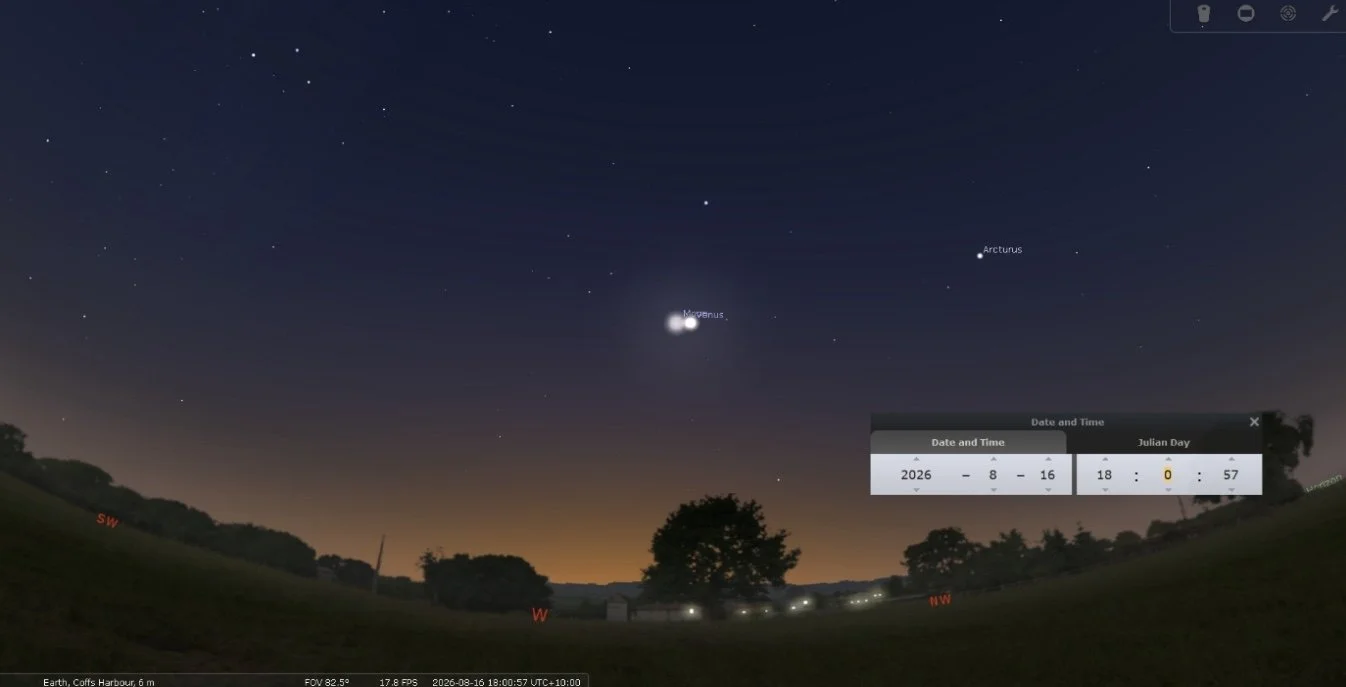
Stellarium Online Star Map
The Venus–Moon pairing as it appears to the naked eye
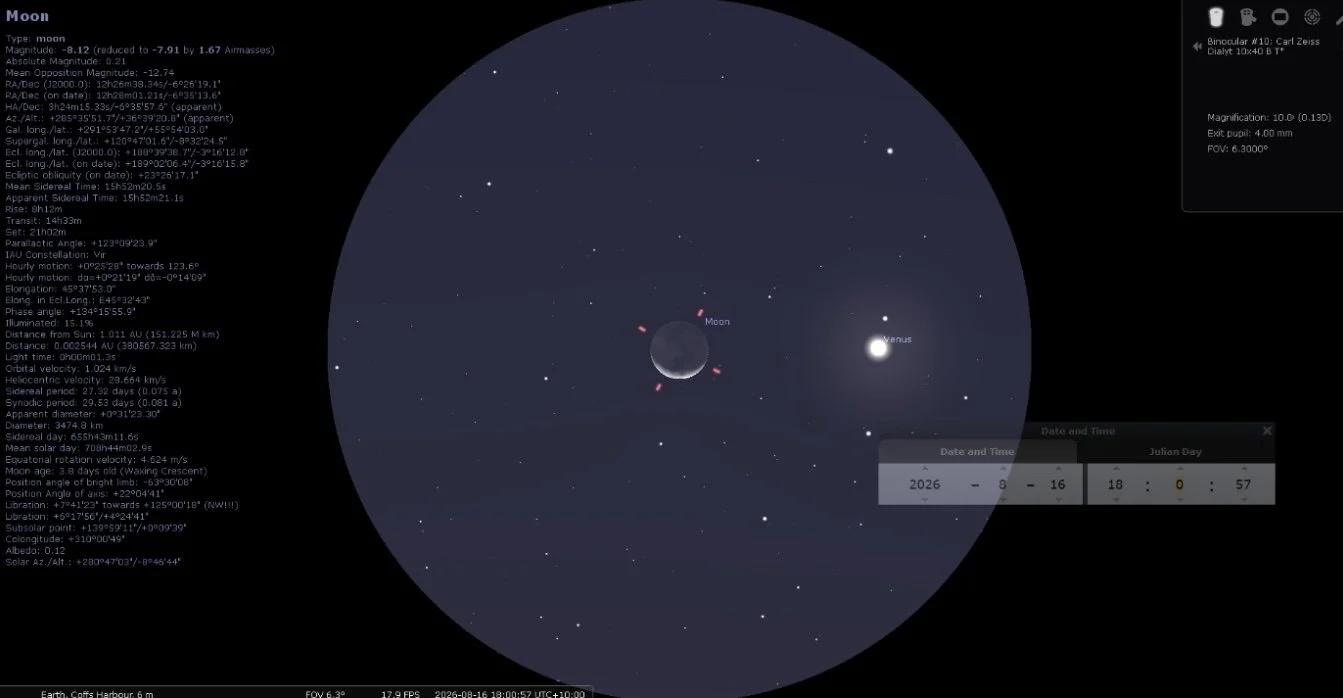
Stellarium Online Star Map
The Venus-Moon pairing as it appears through binoculars
